Credits
- Code — NoRecess
- Articles — NoRecess, Greg, ATC, Grees
- Graphics — Rainbird
- Font — Antoine
Credits from Pouet, completed from the release.
The fourth issue, 1996, and the first to go out under Condense rather than Scorpion. Written with Greg, ATC and Grees, graphics by Rainbird, font by Antoine. Its intro runs on CRTC 1.
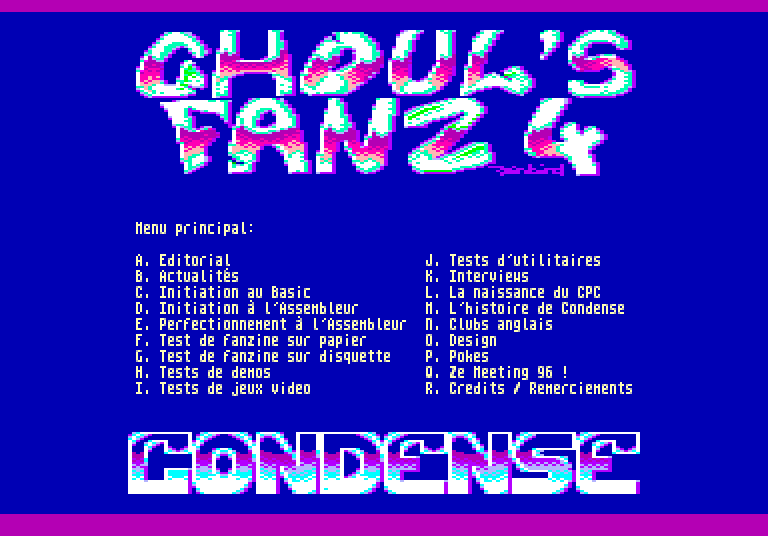
Eighteen sections sat behind the menu, lettered A to R: an editorial and the news, then tutorials — Basic, a first course in assembly and a second one for those past it — reviews of paper fanzines, disc fanzines, demos, games and utilities, interviews, a piece on the birth of the CPC, a history of Condense itself, English clubs, design, pokes, a report from Ze Meeting 96, and the credits.
Read it online
Every rubrique of the issue, read straight off the disc image and published here in the order of its main menu. Pick one to read it.
Choose a rubrique above to read it.
AEditorial
Translated from the text published in 1996.
Welcome to Ghoul's Fanz 4 !
First of all, apologies to every reader of Ghoul's Fanz: I could not keep my promise of an issue every two months… (because of the workload I had, both for school and for the other projects under way, such as Mystery Megademo and Baba Fanz 6).
In the meantime a few things have changed for Ghoul's Fanz. I have decided to stop using Tom & Jerry's Ghoul's Writer. In fact Ghoul's Fanz very nearly changed its name (because the Ghoul's Writer was no longer being used) but then I told myself it was a bit stupid to change the name of the fanzine just for that…
Ghoul's Fanz 4 was in fact meant to fill one side of a disc, packed with some 160 kilobytes of compressed text. But since this issue was keeping people waiting so long, I decided to put out a slightly light one this time, knowing that I would make up for it in the next issue !
Like every other issue of Ghoul's Fanz, there is only one main part. That lets me concentrate on the texts, and also keeps me from spending three quarters of the time making the discmag coding rubriques. I would love to make a fanzine like Dracula Fanz or Demoniak, but I do not have the time to code every rubrique…
As for the contents of Ghoul's Fanz 4, they stay fairly classic: a few beginners' courses, some reviews and various other things, but I never stray from the one thing that concerns us all: the CPC !
I have, on the other hand, cut the usual “assembly” article in two: a first part addressed to beginners, and a second aimed rather at experienced demomakers. The first part is explained in far more detail than the second.
For the reviews, I thought it right to give every production tested a mark. As you will see, some marks are below average… I hope that way to see something other than comments along the lines of “a superb piece of software” when the thing is practically useless… I think that is a very bad way of looking at things: is the CPC scene running on flattery ? Would anyone take that attitude just to see their handle in a greetings list ??? If that were the case, it would be truly sad… You should know that I recently got hold of a PC and that I have started programming on that machine. As a result I may have less time available for putting out new productions… For the future, I think I will stop releasing demos or utilities and devote myself to programming video games alone, and of course to carrying on with Ghoul's Fanz. But that is not for right now…
To finish, I would like to respond to what Targhan of the group Arkos said in his fanzine Demoniak. Greg and I thought for a long time about merging our fanzines (that is, Baba Fanz and Ghoul's Fanz) but we never did it, because we told ourselves that in the end one fanzine would be lost along the way… And besides, if it ever were to happen, I am convinced the fanzine would be no more complete for it !
There you are, that is all. I wish you a good read through Ghoul's Fanz 4. And above all, never forget: the CPC is still alive… and forever !
No Recess.
BNews
Translated from the text published in 1996.
How lucky we are! I'm currently at the Ze Meeting 96, the biggest of all CPC meetings (ahem ahem...). Seriously, it's cool, I'll be able to ask every group present at the meeting for their news... and if possible what they're planning to do (previews).
ARKOS: This group plans to release a megademo pretty quickly, its title is DEMOIZART. DEMONIAK, their disk magazine, is back with a sixth issue (no date given). This issue will be different from the other issues since it will only have one single "text" part (like Ghoul's Fanz). Rainbird also intends to program a strip-poker game in the style of TENSIONS. That's only a project though...
MORTEL: A demo is planned, it will be called NO REALITY. It will be coded by Beast, with graphics by MadE and RSX. PHASER 6, the disk magazine by Seb of the A.F.C, is still being programmed. Let's note all the same that this fanzine is having a hard time coming out, since it was started more than 2 years ago... In the same vein, a demo might perhaps see the light of day, FUCKING EXAM. I don't have any information about this demo. MAT is still preparing his music-box called AKOUSTIKA (see the Interviews section). DRACULA FANZ is also back with a sixth issue. Just like DEMONIAK 6, it will be of the "one single main part" type. It's funny to see that these 2 disk fanzines do pretty much everything the same...
BENEDICTION: This new group is preparing DIGITAL PRESS 3 for us, a disk magazine of the "one single part" type. It will come out during August, it will be programmed by Eliot and the graphics will be by Rainbird. The texts will mainly be in English, but with a bit of French and German behind... They're still preparing their megademo (they're still eagerly waiting for your parts). The few previews I got to see at the Ze Meeting 96 are excellent (plasmas, hardware scrollings, mighty powerful graphics, etc.). A little demo is planned, it will be called BUGS HELL and will be coded by Eliot, Greg and Rainbird.
CONDENSE: A superb game is being programmed, RAGE FIGHTERS. It will be a beat'em'up made up of superb graphics by Greg, and it will surely offer the biggest sprites ever for a game of this category! Another game is also in the works, but that will be for later... It will be a shoot'em'up with horizontal scrolling. BABA FANZ 7 is planned for 5 or 6 months from now, it will be programmed by Greg (farewell Ghoul's Writer). The intro will be coded by Shap, and the end-part maybe by me... All of it entirely in overscan, that goes without saying.
OVERLANDERS: They're preparing a megademo for us which will come out for the Overlanders Meeting. Shap is very busy coding "external" parts like the intro of Baba Fanz 7, the end-part of Greg's Booger Slide-Show, etc.
FUTUR'S: They're still working on AVENTURY. ZACK has finished his game STORMLORD + (it's a bit disappointing for a CPC Plus) and is programming other games whose names I don't know.
CEMPORIA: They're preparing a slide-show for us which will feature animations created with 3D Studio... FANSS 6 is planned for some time in August. Also planned is the creation of the Best Of of FANSS, if possible before the end of the year.
There we go, we've been round all the French news on CPC. It's true that right now, the scene is really moving... Demos are raining down, video game production is getting going again, utilities too, fanzines are dropping like hot cakes into our drives, in short: keep it up!
CBasic for beginners
Translated from the text published in 1996.
INTRODUCTION TO BASIC
Basic. It's hard to find an interesting topic for your dear little blond heads. I feel like teaching the beginners who are starting assembly how Basic can be useful for writing their first demos. No no Dracula, I won't explain how to do ruptures in Basic! (A.F.C revenge!). Apparently, this language may seem pointless to you, and yet... and yet, you'll always need it one day or another!
Let's start at the beginning. Actually, I'm going to teach you Basic through a few very simple instructions (well, sort of...). A Basic program is always numbered. Start your first program, type:
10 REM
20 REM <LOADER>
30 REM
What is this program for? Nothing! It's just to give the program a title. REM means "REMark". Everything written after it will be considered useless by the CPC, so you can put whatever you want there... Anything that goes through your head... even insults I wouldn't dare say! Let's get serious again (oh really?). I strongly advise you to give a title to all your programs... Imagine coming back to your program a year later... how would you know what this or that program is for? Right, we want to do something other than read comments! What's most useful in Basic for an assembly application is loading (to load graphics, musics or whatever...). Imagine you have a sprite to load at address &2000 (this sprite could easily be created with OCP Art Studio (see the introduction to assembly in this issue)), the program from before would become:
10 REM
20 REM <LOADER>
30 REM
40 MEMORY &1FFF
50 LOAD"SPRITE.WIN",&2000
The MEMORY &1FFF is rather hard to explain. Let's just say you must always put the address of the file to load -1. This is very important for the CPC. If the file's address is below &1000, we must replace MEMORY &1000-1 with OPENOUT"D":MEMORY &1000-1:CLOSEOUT ! Don't ask me why, I wouldn't be able to answer you. It must have something to do with the disc drive, but I'm not too sure...
By the way, to see your program, simply type:
LIST
And your program will appear as if by magic. Cool, eh? For now, you already know how to load any binary file; what you should do next is go back to your favourite assembler (DAMS for example). The Basic command is the same as the one we know in assembly:
CALL &4000
If the assembly code lives at &4000. For the earlier example, this would give:
10 REM
20 REM <LOADER>
30 REM
40 MEMORY &2000-1
50 LOAD"SPRITE.WIN",&2000
60 CALL &4000
This program loads the file "SPRITE.WIN" at memory address &2000 then goes back to the assembly.
That's it for now. Later on, it may happen that you need sine curves to create your tables for rasters, bouncing logos, etc... Here's the very simple algorithm:
10 MODE 2:ORIGIN 0,0:DEG
20 MAXY=120:ADR=&3000
30 FOR A=1 TO 360 STEP 1024/720
40 Y=(MAXY+1)+(SIN(A)*MAXY)
50 PLOT A,Y:POKE ADR,Y
60 ADR=ADR+1:NEXT
70 POKE ADR,0
80 END
Where MAXY holds the maximum number of the curve divided by 2. In the example above, 240 would be the biggest value of the table because 240/2=120... To get a more or less "fast" curve (movement-wise, it's very important) you have to change the 1024/720 in line 30. The sine table starts at address &3000 (which is initialised on line 20) and ends with the byte &00. &00 always marks the end of the table. It's handy in assembly for loops that use OR A (or CP 0)...
I'm going to reveal another routine to you that's very useful in Basic. When you make a writer in assembly, you like having your text nicely aligned on the sides. Likewise, you like to type your text with a word processor like Tasword. The solution? The routine that follows!
10 ADR=&4000:LONLIGNE=64
20 SOURCE$="UTILS.TXT":DESTINATION$="NOMFILE.BIN"
30 ADR2=ADR
40 OPENIN SOURCE$:WHILE NOT EOF
50 X=0:LINE INPUT #9,A$
60 LONGUEUR=LEN(A$):A=1
70 LETTRE$=MID$(A$,A,1)
80 IF LETTRE$="" THEN X=0:GOTO 150
90 PRINT LETTRE$;
100 B=ASC(LETTRE$)
110 IF B=13 THEN 150
120 POKE ADR2,B
130 X=X+1:ADR2=ADR2+1
140 A=A+1:IF A<>LONGUEUR+1 THEN 70
150 IF X=LONLIGNE-1 THEN 210
160 FOR A=1 TO LONLIGNE-LONGUEUR
170 ESPACE$=CHR$(32)
180 PRINT ESPACE$;
190 POKE ADR2,ASC(ESPACE$)
200 ADR2=ADR2+1
210 PRINT CHR$(13)
220 WEND:CLOSEIN
230 LONGUEUR=ADR2-ADR
240 SAVE DESTINATION$,B,ADR,LONGUEUR
All the parameters of this program are to be entered on lines 10 and 20. ADR is the start address where the text must be put in memory, LONLIGNE is the length of a line in characters (with Tasword for example, we use the Control and D keys), SOURCE$ is the name of the Ascii file generated by the word processor, and finally DESTINATION$ is the name of the final binary file that will be saved to disc. Simple, eh?
I also feel like teaching you how to change the screen colours (to have a nice design during loading, it matters, doesn't it?). First of all, to change the colour of the screen border, we use the command:
BORDER colour
...where colour is a number between 0 and 26. These numbers correspond to the CPC's colours. To get a table of what matches what, look on your 3" drive, normally it's written on it... And for the colours? Simple:
INK number,colour
...where number is the ink number (for MODE 2, colours can only be 0 or 1; for MODE 1, colours can only be 0, 1, 2 or 3; as for MODE 0, colours go from 0 to 15 (that's 16 colours)). As for "colour", look a bit higher up at the description of BORDER... One last thing, in case you didn't know it yet, to select the graphics mode you must type:
MODE number
...where number is a digit between 0 and 2. The screen is cleared automatically.
Come on, one last little one for the road... To display a message you must type PRINT. Example:
PRINT "GHOUL'S FANZ 4"
The message to display must always be put between quotation marks. As for the rest, well, just read the user manual, I think it's quite instructive... (especially regarding command syntax). Don't forget that instructions must each be glued together with a ":".
Well there you go. To conclude, I'd say Basic really is a simple language. If you're starting out in assembly, I think you'll only need these routines, since I myself have never used any routines other than these for my assembly programs... Yes indeed!
DAssembly for beginners
Translated from the text published in 1996.
INTRODUCTION TO ASSEMBLY
Today, we're going to talk sprites. Indeed, displaying a sprite is very important because you always need it. For a demo, a game, a fanzine... and sometimes even for a utility!
A sprite is a series of bytes stored in memory that represents a picture when it is displayed correctly. You use a drawing program to create sprites: OCP Art Studio turns out to be the dream utility. You make your little drawing, you click on Windows, then on Define Window, then you surround your sprite using the lines that appear on screen. Once the sprite is defined, you click on Windows again, then on File, then finally on Save. Be very careful not to save your sprite in compacted mode.
A file has been created on your disc. You need to know how many bytes your sprite takes in width and in height. For that, use Antoine's Super Monitor. Load your sprite with the L directive, view your sprite through the V directive (press the arrow keys and Shift to view your sprite in its original form, then press the ESC key when your sprite is displayed correctly). You are then given 3 pieces of information: the width (X) of your sprite, its height (Y) and the length your sprite takes up in memory. Careful though, these 3 numbers are given in hexadecimal!
Then, take your favourite assembler and load your sprite at whatever address you want (but not in areas already in use!). We need to create a routine that lets us display our sprite correctly. For that, take a look at this routine:
          ORG #9000
          ENT $
;
SPRITE    LD HL,#A000         ; Source
          LD DE,#C000         ; Destination
          LD B,#0A            ; Hauteur du sprite (Y)
SPRITE1   PUSH BC
          PUSH DE
          LD B,#0C            ; Largeur du sprite (X)
SPRITE2   PUSH BC
          LD A,(HL)
          LD (DE),A
          INC HL
          INC DE
          POP BC
          DJNZ SPRITE2
          POP DE
          LD A,D
          ADD A,8
          LD D,A
          JR NC,SPRITE3
          LD BC,#C050
          EX DE,HL
          ADD HL,BC
          EX DE,HL
SPRITE3   POP BC
          DJNZ SPRITE1
;
          RET
Let me explain. You put in HL the address of your sprite stored in memory, you put in DE the destination screen address (for this routine, only use the memory from #C000 to #FFFF). You also put the height and width of the sprite into the routine (where it's indicated in the source).
On the programming side, nothing very hard to understand, except maybe these sequences of instructions:
          ...
          LD A,D
          ADD A,8
          LD D,A
          JR NC,SPRITE3
          LD BC,#C050
          EX DE,HL
          ADD HL,BC
          EX DE,HL
SPRITE3   ...
This rather special routine gives the screen address located just below the one given in DE. Note that if your sprite is only 1 character high, you'll only need these sequences of instructions:
...
LD A,D
ADD A,8
LD D,A
...
This trick can only be used when DE was pointing, at the start of the routine, to a screen address that began on the first line of a character. If that's not the case, you'll have to do a little calculation like 8 (=1 character) - number of the starting character line, the number obtained being the maximum height of your sprite... Likewise, if you use the stack at the same time to display your sprite, you'll get a really fast routine. All this to save a few microseconds during display...
It's obviously possible to have a routine that's much faster than the one described above, but it's already a bit more complex (and that goes beyond the scope of this section). However, depending on your mail, I might talk about it in Ghoul's Fanz 5...
Normally this article should end here, but I feel like telling you about Flipping, which will also come in handy for the "advanced assembly" section...
So what is flipping? This technique relies on swapping between 2 screens. Indeed, with the technique described above, if you display a sprite that's 40 lines high for example, well, chances are your sprite will appear jerky, "cut". Why? Quite simply because the electron gun "passes over" your animation! That causes a time shift of about 1/50th of a second, but that's enough for the human eye to see the bug...
So, the principle: we take care of filling one screen as we please while another screen is being displayed. When we've made all the changes we wanted on our first screen, we display it, and we then work on the second screen (which isn't displayed), we display our second screen, and so on...
The advantage of this routine is that we can take a lot of time to build our screen. Which means we're not limited to 1/50th of a second to fill our screen! We can still get smooth animation at 2/50th of a second. As for games, they run at about 5/50th of a second (it does depend on the type of game though).
The drawback of this routine - because there is a drawback - is having to use 2 screens instead of just one. This technique can't be used if you want full overscan (full screen) (well, it is possible, but you'd then have to use rupture, and the play area would be rather small in height (half of the screen at most)). On distorted screens, the technique can become interesting! Indeed, imagine a vertically overscanned screen cut in half in height: you could use a single screen (for example at #C000 to get a BC26 routine that flies!). That's actually one of the main reasons of the why and the how of quite a few games having reconfigured screens. In the meantime, it's perfectly possible to do Flipping on normal screens (no overscan), you just have to swap between the screen at #C000 and the one at #4000 (to keep things simple)...
Here's an example of what the routine could look like:
          ORG #9000
          ENT $
;
BOUCLE    CALL #BD19
;
TYPE      LD A,0              ; Ne pas mettre de XOR A
          OR A
          JR Z,TYPE1
          XOR A
          LD (TYPE+1),A
          LD BC,#BC00+12
          OUT (C),C
          LD BC,#BD00+%00110000         ; #C000
          OUT (C),C
          JR TYPE2
TYPE1     INC A
          LD (TYPE+1),A
          LD BC,#BC00+12
          OUT (C),C
          LD BC,#BD00+%00010000         ; #4000
          OUT (C),C
TYPE2
;
          CALL #BB09
          CP 32
          JP NZ,BOUCLE
;
          LD A,2                        ; A=2
          CALL #BC0E                    ; MODE A
          RET
At the end of the program, we set MODE 2 (the graphics mode obviously) to put the offset back to its initial value.
There you go. It looks pretty simple, doesn't it? Every time you change your screen's offset, that's when you'll also have to change the screen addresses where your sprites get displayed. With all that, you can already get started programming a smooth little game! (Well OK, the foundations are laid, it's up to you to do the rest, so there!).
Well there you go. So we've reached the end of this article. I hope you liked it! If you want to see what Flipping can do for you in demos, I advise you to take a little trip over to the "advanced assembly" section!
EAssembly, going further
Translated from the text published in 1996.
ADVANCED ASSEMBLY COURSE
This time, I'm going to introduce you to the techniques of Flipping. This technique is based on swapping screens around. We're going to need it all through this article... (see the "introduction to assembly" article).
Actually, for now, we're mostly going to look at effects that are often used in demos. But be aware that this technique is a must if you want to create a good action game...
I'd like to make it clear that we're going to need to use rupture, and that I'm not going to teach you how to create one, because it's a real pain to explain, and other magazines do it very well (read Quasar CPC for more information on ruptures).
If you've already read the "design" article, in it I talked about the technique used to move a huge logo around using a simple rupture. I'm going to teach you how to move a big logo with word precision (every 2 bytes). You have to display your logo on a screen (like a normal screen). The idea is to change your screen's offset through registers 12 and 13. Indeed, if you put the value 1 into register 13, the whole screen shifts 2 bytes to the left (assuming register 13 held the value 0 to begin with). So we can work out that if we have fun making the value of register 13 vary in regular steps, we can move our screen horizontally... or rather our so-called big logo, if you see what I mean! Right, but as I say in the "design" section, that kind of animation is fast, and it's not very pretty to look at. So there's a simple technique for moving our logo with byte precision... You have to copy your logo into memory twice, with a 1-byte shift. The first logo is screen A, and the second logo is screen B. Picture an animation like SCREEN A, SCREEN B, SCREEN A-1, SCREEN B-1, SCREEN B-2, etc... with 20 as the initial value in register 13 (for screen A), and our logo moves to the right. I know, it's pretty hard to grasp at first, but it's actually really simple. The only problem with this technique is that the logo takes up twice as much video memory, since we've copied our logo to the screen twice. But hey, isn't it better to put up with that little waste of memory and have a nice logo moving horizontally and smoothly? To each his own...
Now let's tackle another effect that doesn't look too bad and has the advantage of using only very little machine-time, just like the logo moving from left to right. I saw this effect in the Dracula's Night Demo (released in the Power System Megademo), but also in the intro of the Digital Orgasm. This effect uses line-by-line rupture, bearing in mind that each screen is 8 lines tall (we don't touch register 9, we just put the value 0 into register 4). The idea once again relies on flipping between several screens: there are 8 of them, each one holding a different step of the animation, 1 pixel apart vertically.
So we'll need to change registers 12 and 13 to get a smooth animation. The advantage of line-by-line rupture (in this case, we'd rather call it "screen-by-screen rupture") is that the displayed screen repeats all by itself. That way, we can make an animation as tall as we like... without losing any machine-time.
Actually, the hardest thing to code for this effect isn't the routine itself, but rather the routine that sets up our 8 screens... For that, the trick is to have a sprite that repeats over 2 lines (for example, you have a CPC sprite at the top, and exactly the same one right below it). So, once you've got your sprite in memory, all you have to do is display your sprite on the selected line, then when you select the next one, you add the width of your original sprite to your sprite's address in memory, and so on... It's pretty hard to explain (and a pain on the coding side) so I hope you got it.
Another nice effect, which is a combination of the 2 techniques we've just seen: differential scrollings. Just look at the first part of the Dark Age Maxidemo or Pict's part in The Demo to see what it is... The idea is simple: you make a sprite that you repeat over 8 lines, shifting it by one pixel each time (in mode 1). Why not 4? Because, let me remind you, we're varying registers 12 and 13, which can only change with word precision, that's 2 bytes, or 8 pixels in mode 1... We also use line-by-line rupture to get our screens every 8 lines. Once you've understood all that, the rest is fairly simple: you vary registers 12 and 13 like this (for 3 differential scrollings, for example):
- scroll 1: 1 + 2 + 3 + 4 + 5 + 6 + 7 + 8
- scroll 2: 2 + 4 + 6 + 8
- scroll 3: 4 + 8
The numbers given represent the screens (the movements of our sprite that we precalculated at the start).
Well, there you go, it's on this fine bit of incomprehension on your part that I'll end this article. Sorry if you didn't quite understand everything I've written... Anyway, I remain entirely at your disposal if you need help, so don't hesitate to write to me!
Next time, I'll go all out and do a whole article on hardware scrollings with byte precision... and those aren't just empty words! And I promise I'll be just as easy to understand as in the previous issues of Ghoul's Fanz...
FPaper fanzine reviews
Translated from the text published in 1996.
Rather than reviewing fanzines everybody knows, I feel like introducing you to a nice little fanzine: the Fanss...
Actually, this fanzine isn't only about the CPC but also about PCs, plus the various hobbies of its authors, namely: role-playing games, music, a comic strip, some news about mangas, etc...
At heart it's mostly a bunch of mates, and you can tell by the lack of seriousness in this fanzine. That's actually one of the main faults you can hold against the Fanss: the spelling mistakes are everywhere (!), the texts are sometimes pretty "catastrophic", the layout sometimes leaves something to be desired (I'm thinking of the comic strip in particular), and as for the humour in the texts, it's often rather lame, but despite all these faults: it's fun!
As for the contents of the issue I've got in front of me right now (issue 5, subtitled "l'extaze !"), they're fairly interesting - let's say funny -... You'll find all the articles mentioned above, notably an introduction to assembly (very badly explained, by the way), news from the little world of the CPC, reviews of PC games (Dark Forces, Cannon Fodder, and others), etc.
To conclude, I'd say that anyone who loves fanzines like Quasar CPC and such won't like this fanzine much, because it's too "lightweight" and doesn't talk about the CPC enough. On the other hand, anyone looking for a bit of fun will enjoy reading the Fanss, because some good times are in store while reading it...
To get hold of it, write to this address:
Le Fanss
41, rue du Champ du Paradis
03100 MONTLUCON
Here's the final verdict: it gets 10/20! (It's pretty hard to give a mark, I hope you'll understand...).
GDisc fanzine reviews
Translated from the text published in 1996.
FANZINES ON DISC
Well no, I won't be reviewing Demoniak 5 or Dracula Fanz 5, since everybody knows them...
I'm going to review a disc fanzine that everybody knows: Baba Fanz. But this fanzine is already well known, so why review it? Quite simply because I've got an exclusive: the latest issue came out a week ago! And for good reason: I programmed quite a few things for this fanzine...
But first of all, let's start at the beginning. So the issue I'm going to review is issue 6; it's on disc and fits on a single side of a disc. More than four months were needed to put it together...
After a RUN"BABA-F6.", you get to a pre-intro (Epsilon-style) and then finally to the intro: at the top you can see a "Scorpion" logo, in the middle some "Baba Fanz 6" logos moving vertically, and at the bottom a hardware scrolling (which, by the way, uses a font transferred from PC). First bad point already: the rupture shakes... Oh well, let's not quibble over that.
Then you get to the main menu. There the result is simple but clear: at the top there's a "Baba Fanz" logo, in the middle the menu, and at the bottom a horizontal scrolling (again with a PC font).
Once you've selected a section, a little "loading" logo appears and the loading takes place. A few seconds later, you get to the section you wanted: you're treated to an article created with the Ghoul's Writer. The design is simple but good-looking.
And the fanzine's contents? They're pretty good. The news is recent, the Basic and Assembly courses are interesting; the various reviews, on the other hand, are a bit tiresome because all the productions reviewed have already been reviewed in another fanzine... The "literature" articles and the article by Grees / NPS are very interesting.
What's really nice is that with every article you select, you can hear a piece of music composed by Greg in person! And in most cases, these tunes are excellent...
When you select the end part, you can see a text (again created with the Ghoul's Writer) and then, instead of going back to the menu, you get a little demo programmed just for the fanzine, which contains lots of rasters and also a nice picture drawn by MAT just for the occasion.
To conclude, I'd say this fanzine is obviously not the best of all the fanzines I've ever seen, but hey, the result is interesting for a fanzine created with nothing but the Ghoul's Writer.
The final mark is... 14/20!
Special message for Epsilon: I reviewed the fanzine by Greg (who is a member of Condense) and I said good things about it, because I think it deserves a good rating. I hope I won't be seeing an "Anthology 2" dedicated just to me... Thanks for your understanding.
HDemo reviews
Translated from the text published in 1996.
The latest demos are really not bad at all! Good thing the CPC scene has been getting a move on for quite some time now. Indeed, I find the CPC scene more active right now than it was 2 years ago! Not very logical, all that... Ah well, moving on.
The demos reviewed in this issue are:
- ANTHOLOGY
- X-FILES MAXIDEMO
- X FILE NIGHT
- X FILE NIGHT 2
- TOTAL ECLIPSE
- REBELLION
- TEN YEARS AFTER
- BORDELIK MEGADEMO
- SPACE DEEP
- MAC BUGS
- DIE KUNST DER DEMO
- MINI MEETING ACT 2
- MYSTERY MEGADEMO
- ANTHOLOGY: The most beautiful production seen in at least 6 months! Epsilon has now reached a good level of programming, and he proves it to us once more with this really innovative demo. The intro of the demo is made of an effect called "Spectral Sprite". These are sprites that distort vertically over the whole height of the screen. A rather special writer shows up between each effect! The second part is made of a writer (with an original display) plus a big Epsilon logo that moves vertically too. It's pretty hard to describe this effect, but it's rather nice to look at, all the more since there are colour blends... The third and last part lets you play 66 tunes directly accessible in memory: that's a new record! All the more since the tunes are all created by Epsilon (as well as the graphics). To conclude, the overall design of the demo is excellent, the tunes are excellent, the graphics too, and on the coding side it seriously rocks! I don't think this demo would be overrated with a mark of 16/20! Excellent work...
- X-FILES MAXIDEMO: This demo was created by the group Mortel. Seb "Candy" has proved to us that he too knows how to do something with his ten fingers! The pre-intro of the demo is made of 2 sprites scrolling by one after the other. The main intro is made of a huge picture taking up the whole screen plus a logo moving left and right and a hardware scrolling. A good little part! The main part was created by Candy: there are several interesting effects, including a big sprite moving left and right, vertical bars, Mortel logos going up and down, a writer, a ball moving left and right, plus several logos scrolling by in an original way. Actually, this part isn't really innovative, but it has the advantage of offering lots of effects on a single screen. Let's also note the presence of a little Epsilon in the demo. This demo is well made and gets 14/20. Good luck for what comes next! - X FILE NIGHT: This demo was coded by me and a friend, Manly. This demo has only one part, featuring a hardware scrolling, rasters moving along sinus curves, vu-meters and a swapping effect between several colours. The design is ugly, the music is so-so (too repetitive), the coding is so-so as well... But you have to understand the context: coding a demo in a single night! And it's possible! So all the graphics of this demo were done by Manly, as well as the weird music, and as for the code, you can well imagine that in 5 or 6 hours you can't make superb demos like the Madness Demo! So the mark is 10/20... No comment.
- X FILE NIGHT 2: Ze revenge! Still in the same context, that is, coding a demo in a single night. The demo is a bit better on the music and graphics side. As for the coding, it's still just passable. You can watch a little ball bouncing left and right in space, plus a checkerboard. The demo also features a writer and a moving sprite. As for the vu-meter, it was entirely ripped off from the one coded by Epsilon in New Arcade 6. By the way, I apologise to Epsilon for not mentioning him in the credits. But hey, in one night you really struggle to code everything, so you take the easy way out, that is, using ready-made routines... Sorry Epsilon! No hard feelings? The general whole of this demo is pretty good even though there's no use of hardware scrollings or such. The final verdict is 11/20. Passable... - TOTAL ECLIPSE: This demo was programmed during the "first SONIC 3' night". This demo is well presented. The pre-intro is made of a static screen, but one where you can listen to a tune that uses digidrums. Not bad! The second part shows several words along the lines of NO LIMITS, AGONY, TRANCE, etc... These words are displayed with a huge font. The colour changes quickly (at the same time as the words appear), so you'd think you were sitting in front of an Amiga (all the more since the music fits the whole thing perfectly!). The main part is made of the same words as before, except this time there are rasters on top, with a writer, sinus dots and a bit of flipping screen (swapping screens). The music is an Amiga adaptation. This demo is of good quality, which earns it a mark of 15/20 !
- REBELLION: It's under this strange name that the latest production of the group Rebels is hiding. Which is a shame, because they were a good group on CPC... Beast was the last active member of Rebels on CPC. He decided to leave Rebels to join Mortel, that French sect that keeps laying fine demos for us... Anyway, we're drifting away from the main point of this article: the review! After loading, you can see a superb logo drawn by Made. This picture shows a robot with a machine gun. Too bad the display is so slow! (a huge vertical scrolling... in soft). Then you reach the main part. At the top of the screen, there's a Rebels logo. In the middle of the screen, little sprites move over a purple background. At the bottom you can see a hardware scrolling. The design of this demo is a real success! On the other hand, the technical side is rather low. Luckily the whole thing comes with a beautiful tune. This demo is really pretty, all the more since the author took his inspiration from the design used on Atari ST. The final mark: 13/20!
- TEN YEARS AFTER: This demo is a wink at the CPC, since it was created 11 years after the birth of the CPC... Not very logical, all that! Well anyway, after loading and a pre-intro, you get to a very simple intro with a scrolling and rasters, all accompanied by nice graphics and a somewhat noisy tune... but a fun one! The scrolling features a weird effect that uses register 2 (for those in the know). This intro is nice. After a press on the space bar, you can see on screen: at the top, a Mortel logo, a bit lower a writer, horizontal rasters using line-by-line rupture, and at the very bottom a hardware scrolling. The main effect is a real success: bars moving along sinus curves, and all of it very smoothly. The effects are very varied. This demo holds 3 cheats which are really easy to find, but I won't reveal them, that'll keep you searching... Mat's cheat is very pretty! This demo is very well made; it's maybe a shame, though, that the tunes are already known. Which earns this demo the pathetic mark of 14/20! Well done guys, that's good work, keep it up.
- BORDELIK MEGADEMO: The Bordelik Meetings series goes on! The participants of the Bordelik Meeting 4 went wild on the coding side to produce... a megademo. No less! This demo fits on one well-stuffed disk side. After loading, you can see a rather nice little pre-intro (in the style of the Bordelik Meeting 3 Demo). This demo holds lots of parts, so I'll only describe the ones I like best. The part by Memory & Rsx (the return to CPC!) is, in my eyes, the most impressive part. All in overscan, this demo offers a hardware scrolling at the bottom of the screen, then over the whole rest of the screen you can see a plasma effect along with 2 lines crossing each other along sinus curves, over the entire screen. This effect is a first on CPC. All the more since the music that goes with the demo is catchy... Note that this demo has an intro containing superb graphics by Rsx... Another part, Epsilon's. This part offers an original writer plus a checkerboard effect that grows and shrinks. It's a shame to note that this effect bugs on the edges of the screen. You can also have fun "killing" Dracula (the boss of Mortel) with a shotgun... The music is nice. Another part, Beast's. A good demo where you can see quite a few scrollings and some sprites drawn by Made. No comment, this demo is very good on the technical side. You can also see a part by Targhan offering a Rolling Sprite effect (see Quasar CPC 9 for more information...) plus an "AKS" moving with sinus tables. The music is truly the technical side of this demo, as it contains "DigiDrums", which are digitised instruments. Good idea... The last part that caught my attention is Orphée's, which uses a Digitracker tune. Unfortunately, he used a music player in his demo that bugs... (Why not use the player from my Digitracker Player utility?). His part is well made all the same, because handling a Digitracker tune is hard (especially when you're using ruptures!). Well, this demo is an absolute must-have, as it's one of the finest productions of these last times (along with Epsilon's Anthology). The mark? Simple: 17/20... Not too shabby, eh?
- SPACE DEEP: This demo was programmed by Tom & Jerry of GPA. After loading, you can see a screen in vertical overscan with a logo taken from the game Space Deep. The music was created by Tom & Jerry and is not bad at all... slow but nice. The main part, for its part, offers a vertical overscan like before. At the bottom of the screen, you can see a writer, then over the whole rest of the screen you can see a Sinus Dots effect where the dots move in such a way that you get the impression stars are coming closer towards the screen (a feel of 3D). The movements are varied, you can even see rotations... The whole thing is very smooth. The music is really lovely, it was composed by Targhan. Note that in front of the stars a very well made writer is displayed (you wonder how Tom & Jerry managed to display it!). The final verdict: 15/20! I love it.
- MAC BUGS: Well well, a demo by the English guy CRTC. This demo offers no overscan but is still very nice. It contains a scrolling (actually a writer in the style of the Fucking Exams by the Logon System) and some very original rasters... Note that the design of this demo is very lovely, the music is pleasant (a non-Soundtrakker music!): that's 13/20!
- DIE KUNST DER DEMO: Created by Shap and Squat of the group Overlanders, this demo offers us a superb pixel-precise sinus scroll plus quite a few technical effects... It's a shame to note that the tunes are already very well known, and that the design is a bit rushed. So the mark is 15/20!
- MINI MEETING ACT 2: Yet another Overlanders demo! Here again, lots of very technical effects, but with a design that's a bit more polished this time. Squat offers a part with a sprite bouncing all over the screen, Shap a part with well-executed rupture, and on top of all that a rather nice little cheat-part (!), and the whole thing fitting into 128 kilobytes! The mark is 14/20. Well done.
- MYSTERY MEGADEMO: A demo created by Greg, Atc and me, with the participation of Rainbird. This demo holds 5 parts plus a cheat-part. The tunes, created by Greg, are of good quality, the graphics as well, and as for the programming, it is fairly good (hardware scrollings, vertical rasters, sinus, etc.). This demo is really good, despite a few parts that are a bit "light". The final verdict: 15/20... Is that overrated ? To tell the truth, I do not think so.
IVideo game reviews
Translated from the text published in 1996.
First of all, I want to take my hat off to the few people who have created games recently, namely Zack, Epsilon, Odiesoft, Bollaware...
The games reviewed for this issue are:
- TETRIS 95
- LOOM
- KARO
- FRESTRIS
- FRES FIGHTER 2 TURBO
- STORMLORD +
The list isn't very long, is it?
Luckily, some games are about to come out, including the much awaited AVENTURY by the FUTUR'S team and RAGE FIGHTERS (a fighting game made by me and Greg). For now, let's get busy with the various reviews of the games of the moment!
- TETRIS 95: Ah, now there's a good game released recently. The principle is simple and known to everyone (no?): you have to stack various geometric shapes so as to create lines, which will then disappear! If you're overwhelmed and the pile of pieces climbs desperately towards the top of the screen, it quite simply means you're going to lose... unless you manage to clear a few more lines... This game is really hard, all the more since the pieces fall faster and faster depending on the chosen level and the time going by! On the production side, there's nothing that can bother the player, this game is pleasant to play. The 2 tunes that come with the game are of good quality, same for the graphics. Note also the presence of a built-in manual, translated into 3 languages (French, English and German). To conclude, I'd say this game is really interesting and deserves the very good mark of 15/20!
- LOOM: Also by Epsilon, this game is the Nth version of Connect 4 on CPC. Actually, I could only see the preview of the game, but hey, isn't that enough to review a game? Bah, I don't know... We'll see with the final version! On the production side, there's a pleasant tune plus a few graphics here and there. In fact, this game is (for now) not really great. Indeed, after TETRIS 95, you could have expected a super hit; alas, what we get is a little game... For example, when you press a key to drop a piece into the grid, it would have been nice to see the piece fall... Well, the PROVISIONAL mark is 12/20. Quite a change from the excellent TETRIS 95!
- KARO: Now here we change register and land among the little games! This game was created by me, in a single day (just for fun). The principle isn't mine but is rather interesting: you have to put back together a figure made of 9 pieces. To do that, we have an empty square that we must fill using the f1 to f9 keys. Alas, each key fills the square differently! On the production side, it's really light. There's no music and no graphics, and you quickly get tired of this far too repetitive game... Which makes for a mark of 09/20! That said, know that another version is under development (with a tune and graphics).
- FRESTRIS: Well well, a game coming to us from Germany! It's yet another version of Tetris. Decidedly, it's all the rage... Anyway, this game takes up the principle of Epsilon's TETRIS 95, with as a variation heaps of options plus the possibility of playing 2 at the same time. Indeed, in TETRIS 95, 2 players could play, but one after the other. Here, it's different: you play at the same time and have a right good laugh! Note also that at each level we're treated to a big background picture. On the production side, it's well done. But there's no music, and the graphics sometimes leave something to be desired... It's a shame: this game gets 13/20.
- FRES FIGHTER 2 TURBO: Well well, a game by the same authors as the previously reviewed one. Actually, I was disappointed by this game, which was supposed to be the CPC version of the famous STREET FIGHTER 2 on video game console. Indeed, there are only 2 characters, and there are no tunes (only sound effects). On the other hand, the graphics aren't too bad. On the production side, it could have been better, then. It's a shame to note that the graphics are in MODE 1: a good fighting game should have lots of colours (well, that's a personal opinion!). So the game is worth 13/20. Again, a shame. It needed more characters!
- STORMLORD +: Ah, now there's a good game on CPC Plus. Actually, I don't have much information about this game as it's only compatible with the CPC Plus. That said, according to the rumours going around about this game, STORMLORD + is much more playable than the original by Rafaele Cecco. The scrollings are "pixel-precise". The graphics are those of HUGH BINNS (the same as in the first Stormlord), and the hero is a combination of 2 hardware sprites. The scenery is stuffed with new traps... and carnivorous plants. The springboards are still there. The tunes are composed by Zik. And the little bonus gift: this game is Freeware (like all the other games in this article) because of the ripped-off graphics... The mark: --/20 (I haven't seen this game, so no mark!).
JUtility reviews
Translated from the text published in 1996.
A few utilities have come out recently. It's a shame to note that Antoine Pitrou still hasn't released anything for a while now because, let's face it, his utilities are really good (I'm thinking of Cheese Cruncher, Font Catcher and Super Monitor)...
Reviewed in this issue:
- X-CONVERT
- DIGITRACKER PLAYER
- HEADER VIEWER
- SCREEN CATCHER
X-CONVERT: This utility was created by Ast of the group Ast System. It lets you turn a tune coming from Equinoxe, Protracker or Digitracker into a SoundTrakker tune (without the instruments, obviously). Which means you can really transfer any music onto your CPC! Unfortunately, it turned out that on the few tests I was able to run, the utility sometimes bugs out... You should also note the large size of the SoundTrakker patterns on the disc (over 20 kilobytes!). But still, despite these few problems, the utility remains very interesting because from now on anyone can use an unknown tune on his CPC in his own productions (demos, fanzines, etc...). Oh yes, this utility is shareware (asking price: 30 francs). Here's the final verdict: it gets 13/20!
- DIGITRACKER PLAYER: This utility, created by me, lets you play any .MDL tune without loading the DigiTracker. But this utility also lets you save a bug-free "player". Oh yes, because even if you didn't know it, the player generated from the DigiTracker is bugged when you select the interrupts (to insert a writer at the same time as the music, for instance !). So I hope to see productions using this player flourish. To conclude, I would say that this utility is not too bad, despite the use of Antoine Pitrou's design: the mark is 13/20 !
- HEADER VIEWER: This utility gives you some information about any file, namely: the start address, the length, the execution address and the file type. Actually, any good piece of software can do the same thing... It gets 08/20! Disappointing.
- SCREEN CATCHER: This utility lets you create a "sprite" file grabbed from a 17-kilobyte screen image. So you can build yourself a sprite animation with no fuss! All the more so since while the sprites are being captured, all the information about those sprites is written on the screen for you (size, width and height of a sprite). The workmanship of this utility is very good, it's the best screen grabber on CPC, and it gets 13/20!
KInterviews
Translated from the text published in 1996.
For this column, I chose to interview MAT, famous graphician of the group Mortel, as well as SQUAT, excellent coder of the group OVERLANDERS...
So let's start with MAT.
Can you introduce yourself to the readers of Ghoul's Fanz (name, first name, age, studies, etc)?
Gauzentes mat 18 years old in première elec graphician and apprentice coder at Mortel (or Mortadel for some...)
Can you tell us a bit about the group you belong to?
We are 9 more or less active(!?) people in the group: Dracula alias ze big boss the one who dishes out all the work
Ramlaid,Beast,Seb et moi au code
Roce et re-moi pour les gfxs
Cracky qui fait des traductions
What do you think of the current CPC scene? and yourself?
Your projects? Akoustika?
AAAhhh! Akoustika! I've had it planned for quite a while now(almost 2 years!) but I don't have enough time to move it along.. too many gfx to do! (hi Dracu!).
Apart from that my second project is to get back to my bed real quick!!!
A little message before you leave us?
Thanks for the interview and for the little chat just now!!
That was brief, but now we know a bit more about MAT and his group... Let's move on to SQUAT!
Can you introduce yourself to our faithful readers? well ok I'm 15,I've been coding in assembler for about 3 years. I got a cpc at the age of 10 and quickly started doing basic,but everything changed when I met SHAP.... (NRS's note: You two gay or what??) no I formally deny it!!! Actually he taught me the basics of demo making.
Apart from that I'm moving up to première next year to prepare a science bac... I'll give you my name and my address if you want to contact me
LONGOUR Guilhem
34,rue de l'ormetteau
77176 savigny le temple
Your group, Overlanders, is new. We want information! actually overlanders isn't new at all !!! we simply didn't know a CPC scene existed and vice versa,that's all ! overlanders has been around for about ten years (!!!) the group started with SHAP (who was YES back then) and STV,the graphician,in 1987. their activity was based essentially on cracking. then two new members arrived, CRAX and BART,around 1989,alas those two members have now quit the CPC... the group's goals then evolved towards demomaking.... I got in touch with SHAP around 1992 and at the time I was trying to learn assembler. but all alone it was hard. SHAP taught me the basics of demomaking and little by little I started making progs that weren't too bad... it was also around then that SHAP's contacts started quitting the CPC,and we found ourselves cut off from the scene. then we came to believe more and more that we were the only survivors of the CPC,but we still kept on making demos ! we did give SYNTAX ERROR a phone call from time to time though,and he sent us the sources of his demos...
Syntax Error... back on CPC? that's completely false,actually those demos are going to be crunched and spread by TOM&JERRY (the FANTASY is finally going to come out !) but that changes nothing about the fact that SYNTAX ERROR isn't on CPC anymore...
How did you get into the scene?
SYNTAX ERROR told us there might still be a few CPCists left and that we could find them on minitel... we had to wait a while longer to get one lent to us,and then we searched on ACPC and RTEL. Nothing on ACPC but we managed to get in touch with TOM and JERRY on RTEL,who told us about the existence of a CPC scene totally different from the one we had known ! you can imagine our joy when we learned that several megademos had come out during the year !! let me point out that these events took place in January 96 (only 6 months ago).
Tell us about your first demo... by the time we got in touch with TOM and JERRY I had created an interesting pixel-precise sinus scroll routine and SHAP was starting to do some really wild stuff on the hardware side (a field that is very obscure to me !),so to make a name for ourselves we decided to release a demo ! it was finished a bit in a rush (we were in a hurry to get it out) and that's why the design looks a bit "botched"... so far we've released 3 demos and this one is by far the most technical.
And the future? we're preparing a "bloodwych"-style game but much more complex,with a syntax parser for the dialogues with the monsters and an option to create your own mazes ... well this game will come out in about two years (!),because it's a very big project... which won't stop me from releasing demos all the same !
A message before you leave us?
CPC FOR EVER,don't forget it man !
Well, there you have the end of this very interesting article. Next time, in Ghoul's Fanz 5, I'll be giving you, as a world exclusive, the interview with Longshot of the group Logon System! So, surprise...
LThe birth of the CPC
Translated from the text published in 1996.
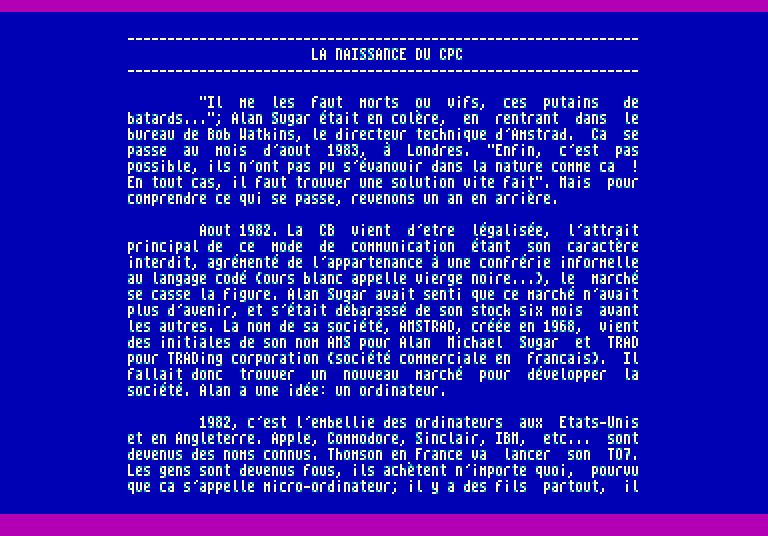
"I want them dead or alive, those bloody bastards..."; Alan Sugar was fuming as he walked into the office of Bob Watkins, Amstrad's technical director. This is happening in August 1983, in London. "Come on, it's just not possible, they can't have vanished into thin air like that! Anyway, we've got to find a solution, and fast." But to understand what's going on, let's go back a year.
August 1982. CB radio has just been legalised; since the main appeal of this means of communication was its forbidden character, spiced up by membership of an informal brotherhood with its own coded language (white bear calling black virgin...), the market falls flat on its face. Alan Sugar had sensed that this market had no future left, and had got rid of his stock six months before everyone else. The name of his company, AMSTRAD, founded in 1968, comes from the initials of his name: AMS for Alan Michael Sugar and TRAD for TRADing corporation. So a new market had to be found to grow the company. Alan has an idea: a computer.
1982 is the heyday of computers in the United States and England. Apple, Commodore, Sinclair, IBM, etc... have become household names. In France, Thomson is about to launch its TO7. People have gone mad, they'll buy anything at all as long as it's called a microcomputer; there are wires everywhere, you have to buy cassette players, power supplies that blow up, hog the television set, the manuals read as if written in Papuan, and it's utter chaos with the converters, and go plug your PAL into the SECAM... In short, it's a nightmare, but it sells like hot cakes. So, in this late summer of 1982, Alan Michael Sugar sits down to design a microcomputer. Not on the technical side, since he knows nothing about that, but on the practical side. He draws a computer and puts a screen with it (nobody had thought it would be easier to sell and to build that way), two wires, a nice console: a keyboard and a built-in cassette player. A big keyboard, so the buyer feels he's buying a professional tool. It's one of the fundamental laws for AMS (I'm not going to keep writing Alan Michael Sugar!): the consumer must feel he's getting far more than his money's worth, and far more than anywhere else at the same price. So AMS's computer is good-looking and simple to plug in, like the Hi-Fi systems that made his fortune, even if people tend to call them audio systems instead.
Since neither AMS nor his technical director know anything about computing, they call in two engineers who have already worked for AMSTRAD, and who claim to know their stuff. So while AMS and Bob Watkins concentrate on the machine's outward appearance and its ergonomics, they assume their engineers are making the same kind of progress on the machine's insides, based on a 6502 processor (like the Apple 2 and Commodore 64), 32 K of memory, 8 or 16 colours. Crash, bang: our two engineers had flexed their biceps a little too hard, and when they realise they won't be able to deliver what they promised AMS, they take to their heels...
Which brings us back to the start of the story, and AMS's black rage. "Bob, you're going to find those bloody swine for me! But at the same time, we need a fallback solution, fast. Any ideas?" Bob racked his brains for a few moments. "We should talk to those Ambit people in Brentwood, they've worked for us several times: there's that fellow Roland Perry, and William Poel, one of Stan's pals. They know about computers, they even publish an electronics journal." Stan Randall had been sent by AMS to Hong Kong to set up the Amstrad subsidiary in the Far East, which handled supplies and subcontracting. "That's a possibility... they helped us a lot with the CB business, give them a call. And don't forget to find those two crooks for me, Bob..." Bob Watkins first made an appointment with Roland Perry for the next day.
Amstrad's premises were located in one of the warehouses of a suburb in north London, Hackney. There was nothing particularly inviting about the look of them. August was the time of year when the big hi-fi retail chains, the equivalents of Fnac or Darty, were stocking up for the Christmas season. Thousands of boxes of radios, audio systems and loudspeakers passed through those warehouses at that time of year. Bob Watkins threaded his way through the boxes to his office. He picked up a box containing the prototypes of the computer, and drove to Brentwood, a small town twenty kilometres from London, to Roland Perry's office. He set the box down on the desk. "I hear you know about computers. Well, we have this microcomputer project, and the people who designed it can't cope. Could you take on the job: I mean, finish it for us?" Amstrad had to launch its computer at the start of '84.
Bob and Roland talked microcomputers. In the summer of '83, the English market was dominated by Sinclair with its Spectrum, Acorn with the BBC, the Commodore 64, and Oric, all sold without a screen, at prices ranging from 1500 francs to 4000 francs. The market for 1984 could be estimated at close to a million units, hence Amstrad's interest in getting into it. Bob showed him the keyboard and the circuits: "The outside of the machine is practically settled. What remains to be seen is whether we can keep any of the circuits those idiots designed." Roland glanced over the work done by the two useless characters. "Hmm, not very professional, this stuff"... "When do you need an answer?" - "Three days..." - "I'll see what I can do".
So Roland was behind the first Amstrad ever put on sale: the CPC 464. He had no idea what an ordeal he was letting himself in for, nor that by the end of 1990, 10 million computers would have been sold.
Roland had arranged to meet Richard Clayton at the offices of Locomotive Software, a young English company producing software for microcomputers. They were located above the slaughterhouses of the town of Dorking, twenty kilometres south of London. Richard stepped into the next office, that of Chris Hall, the boss, to let him know Roland was coming.
"Hello, Roland." "Hello Richard, hello Chris." "What have you got in your box?" "Take a look, apparently it's a computer." Richard opened up the keyboard and peeled off the tape covering the fateful name: AMSTRAD. "Amstrad? Never heard of them." "Better forget that for now, top secret." "What do we have to do with it?" "You're the specialists in operating systems and in Basic, so I thought of you for that part, but I still haven't found the rare bird who can build us the circuits that will run with your Basic. Any ideas?" Of course they had an idea. Mark-Eric Jones (MEJ to his friends) was also a member of the Cambridge gang, like Richard — a gang whose origins go back to the 70s, and who long believed that computing would bring about a better world. Their gentle idealism doesn't stop them from keeping their feet on the ground, and they are behind most of the successes of English microcomputing in the 80s. MEJ had founded his own electronics consultancy, specialising in the design of printed circuits for microcomputers.
Nearly all the characters of the CPC 464 saga are now on stage. We are in August 1983, in Dorking, Surrey. In an office with an unbeatable view of the slaughterhouses, at Locomotive Software, are gathered: Roland Perry, Chris Hall, Richard Clayton, Mark-Eric Jones, Mike Scase, William Poel. Mike Scase is Mark-Eric Jones's partner at MEJ electronics, and William Poel is Roland Perry's boss. On that August afternoon in 1983, six men are writing a small page of microcomputing history.
In the course of that memorable evening, it was decided:
1 - The central processor, a 6502 in the original project, would be replaced by a Z80. Indeed, MEJ knows this processor much better, since at Data Recall they worked on Z80s; Locomotive Software had just written a Basic for the Z80, and since the Spectrum was based on the Z80, it would be easier to adapt Spectrum games to the new Amstrad.
2 - The computer's code name would be ARNOLD, so that everyone would believe General Electric Company was behind it, its boss being one Lord Arnold Weinstock. Roland Perry would notice later that ARNOLD is an anagram of ROLAND.
3 - The top-secret code name would be IDIOT — nothing to do with the French word, since it stands for It Does It On Tape (it runs on cassettes).
4 - The real name was to become CPC 464 (Colour Personal Computer): 64 because it had 64K of memory, and a 4 in front to go one better than the Commodore 64 (NRS's note: the 4 stands for the presence of a cassette player).
5 - In designing the circuits, MEJ would use GATE ARRAYs — in other words, chips that each replace dozens of others. It's harder to do, but it's cheaper. And what's more, it's almost impossible to copy.
The six friends had remade the world of microcomputing in six hours. One of them came out with this: "Hey, guys! You're joking! Sugar will never go for that!" They were wrong: Sugar went for it, and became very rich...
The next day, both Locomotive (Richard and Chris) and MEJ (Mark-Eric and Mick Scase) were telling themselves that the previous day's samba would come to nothing. "Changing the microprocessor in a machine already under development — unthinkable!" They didn't know Alan Sugar yet. That very day, a meeting in London. William Poel, Chris Hall and MEJ find themselves facing Bob Watkins. AMS arrived late, and Bob was taken for the boss for quite a while. Then Alan gave them a lesson in philosophy and marketing they never got over: "You see, I bought a few computers before starting my project. Frankly, they're crap. Not in what they can do — that I couldn't tell you. But when I sell a Hi-Fi system, it doesn't take two hours to plug it in. With these Sinclairs, Orics, Commodores, it's a pain like you wouldn't believe. You never know which wire goes where, you get into a hopeless muddle with the monitors, the television sets, the power supplies, the cassette players, wires and more wires that are never the same. What I want to sell is a computer the average Englishman can be using within five minutes of buying it, which means: monitor supplied, cassette built in, and when you switch it on, there's a message on the screen."
Someone dared to ask a question: "At what price?"
"That's not your problem. I want the cheapest computer possible, with the maximum of capabilities. 64K of RAM, 32K of ROM, the keyboard and the built-in cassette drive you have seen, a graphics monitor, the possibility of plugging in a printer. I designed the outside of the machine myself; it is up to you to put the best you can on the inside. Bob will give you the limits on cost. It has to work and it has to be ready in January. Understood ?"
"On the software side, we need a hundred or so prototypes to hand out to the software houses by the end of November. They will be assembled in England, for the sake of speed."
The three participants from outside Amstrad were impressed; besides, this was mission-impossible territory. When IBM designed their first computer, they had put some fifty engineers on the job, more than a hundred outside consultants and a myriad of subcontractors, and bringing the project home in one year was considered a feat. And here they were, being asked to do it six of them, in five months. And in they dived — William and Roland; Chris and Richard; Mark-Eric and Mick; and the others... Not one of them ever regretted it.
19 August 1983. Roland has finished. The project is defined. Unbelievable: a computer in under a fortnight — circuits, software, hard-wired software (firmware, as they say) all set down on paper. On this Friday 19 August 1983, Roland Perry has before him the specifications sheet of the computer he has committed to designing with William, MEJ, and Locomotive. The specifications sheet of Arnold, alias IDIOT, alias CPC 464, is sent by telex to Bob (there were no fax machines yet). It is the official birth certificate of the CPC 464. From August '83 to April '84, the CPC 464 would take shape, above all on the inside.
3 January 1984. "So, where do we stand?" "Well, since we picked up the trail of our two jokers in the Lake District (in the north of England), it went cold in a hamlet perched up in the mountains..." "I don't want to talk about that, I want to talk about our CPC." Alan and Bob burst out laughing at the same time. "Richard Clayton is due to show the machine to Guy Kewney" (the most famous computer journalist in England, of Personal Computer World). "And the ROM?" "Locomotive thinks it can keep its commitments and get it to us on 21 January." "So, launch of the machine at the start of April..."
Alan's philosophy, where products are concerned, is this: at 10000 francs, you tell yourself I'd love it but it's too expensive; at 8000, it needs thinking about; at 5000, I could buy it for Christmas; at 2000, you buy it without delay. Find the price that will make the consumer crack, and work backwards to reach that price while still clearing the necessary margin. Every centime saved on a component, over millions of units, adds up to a lot. Alan and Bob reason purely in terms of time and money.
On 21 January, the ROM designed by Locomotive Software and the special ULA chip designed by MEJ had to be sent to Japan so that production could begin. The first ordeal was that ULA: it replaced 35 components with a single one, and getting it right had been the nightmare of Mark-Eric's life, with the people at Ferranti who were working on it making mistake after mistake. Ever cautious, Alan had decided to take on a second subcontractor, the Italian company SGS.
The design of the Basic and the Firmware went ahead without any major mishap, except that working hours at Locomotive were anything but standard, and weekends nonexistent. All of which produced a Basic quite out of the ordinary: in October 1984, one could read in Science et Vie Micro: "The CPC 464 outclasses every 8-bit machine on the market and will even beat the IBM PC, placing itself comfortably mid-field among the 16-bits".
A computer is all very well, but you have to give it something to eat. But just try convincing a software designer that he should work for a machine that isn't even on sale yet, when he's earning good money developing his game for Sinclair, or Commodore, or Thomson (Alice and Matra, on the other hand, were a fiasco). So William's job is a hard one. He deploys his charm and his powers of persuasion, repeats the same speech a hundred times, a thousand times: "Look, of course it's a new machine, but it has a Z80 like the Sinclair, so you can adapt your software quickly, and besides, the Amstrad has 27 colours, .........". And the waltz of the prototypes begins. Fifty machines, with Amstrad television sets converted into monitors, are produced with whatever is to hand. With five to six times more components than the final machine, these prototypes are marvels of tinkering. They work, and almost like production machines at that. As soon as a developer shows signs of fatigue or rejection, the machine is whisked away to win over another software house. Most extraordinary of all: during the six months of this uninterrupted waltz, only one machine would break down — and even then, only its power supply. The software was on its way, the fever was rising. Slowly but surely. What was going to happen? Nothing. January 1984 went according to plan, the prototypes did the rounds. On 21 January, the fateful day, the ROM and MEJ's ULA were ready — immediate shipment to Japan.
23 January 1984. Catastrophe. Richard Clayton calls Roland Perry: "Blast, I've found a bug!" "What's your bug?" "I don't think anyone will find it easily, but it's a bug all the same. It has to do with a relative-movement command...". Since there's no risk of it crashing a program or bothering the software houses, Alan quite simply decides to flag it in the firmware book. It's no catastrophe. Amstrad had promised software designers 50 pounds sterling for every bug found in the firmware. They never had to pay: nobody ever found the one bug Richard Clayton knew about. Full steam ahead — the launch is set for 10 April 1984. Indeed, the tests carried out on the ROM and the ULA prove that the design is sound. All that remains is to supply the documentation.
Because a manual is needed, and books. Many books would be devoted to the CPC range: since 1984, more than 1000, including nearly 300 in French. So, in January 1984, Amstrad starts writing the CPC manual. The Locomotive people, in their wisdom, have already begun the Firmware book. That's Richard Clayton's method: every time he defines an instruction, a command or a function, he writes the comments and explanations, which are then carried over into the book. Elementary but brilliant. Writing a manual is no simple matter. The connoisseurs can accuse you of being too simple, while the beginners get lost. But they pull it off. The magazine Votre Ordinateur of October 1984 would write: "It is a big, very complete binder of 250 pages. It is aimed at everyone; each of the 158 instructions is explained, illustrated with an example, and the associated keywords are always indicated." The one problem with this manual is chapter 6, on sound. Written by an expert rather too fond of theory, it is hard to understand.
The fateful moment draws near. In February and March, the software starts coming back to Amstrad for testing. In March too, Alan decides the CPC needs a disc drive. MEJ, Roland Perry and Locomotive congratulate themselves on having planned for this need from the very start, and William Poel is given the job of contacting Digital Research to adapt CP/M to the CPC. At the time, CP/M is still an important system, and the only worthwhile one for an 8-bit machine. Later on, a million and a half machines would be fitted with the CP/M system. The fateful moment arrives.
10 April 1984. 10 o'clock, outside the great hall of Westminster School. The journalists and the computing gurus, plus two or three financial experts from the nearby City, have made the trip. In all, four hundred people are waiting for the doors to open. All the protagonists and craftsmen of the CPC are there — Alan, Roland, William, Richard, Chris, Ivon, Gill, Sally, Mark-Eric, Malcolm, Mike and others — except Bob Watkins, for two reasons: he already has other machines in preparation, and above all, he is superstitious. The demonstration begins. In a flash of genius, the public relations agency has found in the phone book the names of five people, each of whom will give a demonstration. True story! Mr Ravel presents a music program, the Bolero. Mr Monet shows off the machine's graphics capabilities, Mr Shakespeare rewrites one of the plays with an in-house word processor, Mr Archimedes and Mr Einstein demonstrate the machine's powers of calculation. Locomotive Basic can work out the logarithm of Pi to 16 significant decimal places.
Alan Sugar speaks before the assembled crowd, and announces that Amstrad has created a software subsidiary, Amsoft, and that 50 programs will be available when the machine goes on sale. The machines will come from Korea, where they are built under licence. Having talked marketing, Alan passes the micro (the microphone) to Roland to talk about the micro (the microcomputer). And after Roland's technical rundown, Alan takes the micro back to announce the price: 199 pounds with a monochrome monitor, 299 pounds with a colour monitor. Alan promised that the first machines would be at the retailers within the first fortnight of June (Clive Sinclair had taken more than a year between the announcement and the delivery of the first QLs, the computer that probably caused his bankruptcy). William Poel added: "If the first Amstrads are not delivered by the end of June, I undertake to eat a CPC 464 in Trafalgar Square."
The press is unanimous: the Amstrad is going to be a smash hit, provided the 200000 units get delivered. Every magazine compares the CPC to the other machines; it beats them hands down. The first shipment of CPC 464s left Korea on 10 May. Given that a boat takes five to six weeks to reach England — assuming it doesn't sink — William will not have to eat a CPC 464. Phew: on 21 June 1984, small queues formed outside the shops that had received the computers the day before. In two hours, everything was sold. Some customers had even come from Belgium and Holland; one arrived from Bahrain by plane to collect the machine he had reserved. But what stands at the centre of Alan's activities in June 1984 is export. He has no intention of attacking the American market — Europe and the Far East, rather. Alan is going to push his pawns into France, Germany and across Europe. And first of all over at the frogs' (that's what they call us, the rosbifs!)
Amstrad France is a small limited company with 20000 francs of capital, whose emblem is a crocodile. Which earned it a spot of trouble with Lacoste. Since 1982, it has sold a few thousand audio systems. Its customers are supermarkets, a few retailers, and La Redoute in Roubaix. Marion Vannier runs it; her second-in-command is Marcelin Daniel. He's the one who does everything: deliveries, customs, missing or damaged goods, invoices, chasing payments... He knows every one of Amstrad France's customers. Marcelin is none too reassured at having to sell microcomputers. How do you go about selling them? Who is going to repair them? What do you tell the customers who come asking questions? And then, the competition is already in place. Thomson with its TO-7, Sinclair with its Spectrum, Commodore, Atari, Oric, a little Electron from Acorn, Philips with its VG5000, Laser, Aquarius, two little French machines, Hector and Excelvision, the Japanese with the MSX standard, represented by Canon, Yamaha, Yashica, Yeno, Sanyo, etc... and not forgetting Alice, that little red computer with a RAM of 4096 bytes! In 1984, 31 different models are on record. So Marcelin is worried. In the professional field, the tussle between IBM and Apple is just beginning. The first CPCs are due to arrive in France in the second fortnight of September. Which leaves little time to translate the manual, and the instructions for the fifty programs that will accompany the launch. For the games, no problem, but for the educational and professional software, it's no piece of cake.
Fortunately, the CPC 464 is a good machine, and although sold a little dearer than in England on account of VAT and of a better margin (2990 francs with a monochrome monitor and 4490 francs with a colour monitor), it sells like hot cakes. The first 4600 Amstrad CPC 464s to arrive in France were sold in two weeks.
If the rest of the Amstrad adventure fascinates you, I'll tell it to you in a coming GHOUL'S FANZ. Before leaving you, here are the titles of the first games to arrive in France. Harrier Attack becomes Exocet in French, Roland in the cave becomes Roland à Lascaux, Hunter Killer becomes 30000 lieues sous les mers, Laser Warp becomes Attaque au laser... The fact that Amstrad entered the market relatively late spared it a certain number of duds, but you could still come across horrors of the Pilote de Grand prix kind, which would sell several thousand copies... Among the games worth remembering, in the machine's early days, let's mention Roland voyage dans le temps, and above all Sorcery.
MThe story of Condense
Translated from the text published in 1996.
Condense is a brand new group made up of Greg and myself, No Recess. Actually, there won't be any other members in this group because we're already complete: one musician and graphician, and one coder.
But how did Condense come together, actually?
It's a long story.
It all started a year and a half ago. Back then, I got to know Rainbird / Arkos (through his address, which I had found in an old issue of Amstrad Cent Pour Cent). Thanks to him, I was able to learn assembler and also get lots of other contacts. When I started managing to string 4 lines of assembler together without mistakes, I looked to join an almost unknown group: Scorpion...
Ah, Scorpion... Good memories. I got to know Sonic 3' and ATC. Some time later, Greg (who was doing his Baba Fanz back then) joined us along with Babar. We were a good team and we started a few things together (Booger Slide, Baba Fanz, Ghoul's Fanz...).
Time went by... Keeping in touch got harder and harder (Sonic 3' wasn't answering my letters, and I'd had no contact at all with Dunk and Babar even though they were members of Scorpion...). In the end, the only people I was in touch with were Greg and ATC. We actually started our Mystery Megademo together.
Everything was going fine, but since ATC was turning more and more towards the PC, Greg and I then decided to leave Scorpion to found a new team: Condense.
We do want to keep very good contacts with Scorpion though: when we left the group, all our productions that were still being programmed remained Scorpion productions. Besides, just look at the Mystery Megademo which has just come out with this issue (along with Baba Fanz 6)...
Now, some people I won't name have called us quitters. Indeed, we had a few problems with the Acid Music Box 3 and some wrongly thought we left Scorpion after screwing everything up there. For pity's sake, don't think that, it has absolutely nothing to do with it!
Let's look at things today: Scorpion is an almost dead group. Sonic 3' (the group's excellent Basic programmer) is hyper-productive... As for the other members, I'll say nothing... There's only one person I'll miss: ATC. I hope to keep up good contacts with him for the years to come...
So let's get back to Condense.
So this group is brand new, and already out in the catalogue are:
- Digitracker Player
- Ghoul's Fanz 4
- Karo
And as "Scorpion / Condense projects", now finished: - Baba Fanz 6
- Mystery Megademo
There you go, you know everything about Condense. I hope everything will go well for us in the CPC scene, because we've already had a few problems recently. Could that be down to our young age? (16 for me and Greg).
Well, there you go... to finish, I'll say just one thing: "Condense for ever!".
NEnglish clubs
Translated from the text published in 1996.
During my short stay in England, I discovered that the CPC was still very active, notably through clubs dedicated exclusively to the CPC and nothing else.
Here in France, we have our A.F.C. (well known to everyone). Well, over there, there's the U.A.U.G. and WACCI...
U.A.U.G. stands for "United Amstrad User Group". This club was founded in 1986 by passionate CPCists who were disappointed with overpriced software, incomplete magazines, unavailable Freeware programs, etc. The main goal of this club is to bring together all Amstrad CPC users.
The U.A.U.G. offers you some pretty interesting services: - a bi-monthly magazine
- discounts on software and interfaces (if you buy all that by mail order, it can be very useful...).
- a very large library of public domain software
- books about the CPC to buy / sell
- help, advice, etc...
I can't describe here how all these services can be useful to you, but let me tell you, it's all really very interesting!
None of this is free, of course; to be a member of this club you'll have to pay (from France) about 110 francs. That may seem expensive, but with all the advantages you can get on the side, this investment can really pay for itself!
For more information about this club, write to this address (in English only!):
UNITED AMSTRAD USER GROUP
Mr G. Woolliscroft,
2 Wrenbeck Drive,
OTLEY,
West Yorkshire,
LS21 2BR,
Great Britain.
Now let's move on to the second big club that caught my attention during my time in England.
WACCI — I don't know what it stands for. But on the other hand, I do know what it can do for you! WACCI isn't a club in the same style as the U.A.U.G. Indeed, the latter is mostly about "services". WACCI is a plain club just like the A.F.C., meaning it's a gathering of people who share the same passion (the CPC) but who also publish a magazine. For the A.F.C. it's a newsletter of 3 pages at most. For WACCI, it's a 32-page magazine!
WACCI has been around for quite a while and enjoys ever-growing success despite all the problems our CPC is going through these days. Just take a look at the club's magazine! The latest issue (issue... 97!) is splendid: listings, news, competitions (with prizes!), the latest public domain softs (that we don't know about and which look really interesting), small ads, articles and more articles!
This club is, in my opinion, the finest club still alive on our CPC. The A.F.C. looks really tiny compared to all these fantastic clubs...
And how do you become a member of this club?
That's where it gets very interesting: you only have to pay for the magazine to be a member, knowing that the magazine costs about 20 francs including postage... So??? What are we waiting for to rush into this club?
For more information, contact:
WACCI
7 Brunswood Green,
Hawarden, Flintshire,
CH5 3JA,
Great Britain.
The drawbacks of these 2 clubs are that they're both located in England, and that as a consequence you have to speak English fairly fluently! But hey, you get used to it quickly...
By the way, believe it or not, I found these clubs' addresses in magazines for 8-bit computers, so all this really is serious stuff.
Personally, I've been very disappointed by the only French club we have, the A.F.C. Indeed, only the newsletters were fairly interesting (the services offered by the A.F.C. turn out to be pretty useless), and even then, only when you actually receive them. It's been more than 3 months since I last got a newsletter. If you think about it and consider all the stamps I sent at the beginning when I signed up, isn't there a little scam in all this? Oh well...
ODesign
Translated from the text published in 1996.
Let's talk a bit of "design". Indeed, making demos with nice effects inside is cool. But making demos with nice effects and great design is even better! Design is the way things are presented on screen. It's what makes it look good, you know!
Design depends on several factors: the colours, the graphics, and sometimes even the effects used!
Let's start with the colours. You always put a dark colour behind a light one. The colours often used are black (colour 0), dark blue (colour 1) and purple (colour 4). Dark red (colour 3) isn't used very often. As for dark green (colour 9), that colour is practically unusable for the background! There are also colour combinations for graphics (knowing that the most used graphic mode is mode 1, which has 3 colours + the background). These famous combinations are:
- blue: 1, 2, 14 or 5, 14, 20
- red: 3, 6, 15 or 6, 15, 25
- purple: 4, 7, 17
- green: 9, 19, 22
I think colours play a big role in design. Picking ugly colours means wasting a demo, even if the demo in question is very technical on the programming side... There are also the "little extras" that play a part in the overall feel of the demo. For instance, imagine a horizontal overscan screen with a blue background (colour 1) and a purple border (colour 4). Well, even if for now the design looks fine, add a white line at each end separating your screen from the border. And there, that looks better, doesn't it? On the programming side, I prefer to use a raster rather than a "real" white line, because that way you keep an ink. Well yeah, imagine: you've got a graphic using the colour combinations quoted above; if you had to draw a white line "with POKEs", you would necessarily have to use an ink set to white, and therefore sacrifice an ink if you weren't already using white...
There's also design "on the programming side". I think it's better to make small, smooth animations rather than one big sprite that jerks as soon as you try to move it... Oh yes, because that can ruin your demo! Likewise, it's better to avoid moving a huge logo left and right using a simple rupture, just by changing the screen offset (to be clearer, by applying a variation of about one word per frame to your sprite). In that case it's better to use the flipping technique (see the assembler course), because the logo moves fast, too fast even, and then you can't appreciate the logo at its true value... and besides, all that hurts your eyes!
Well, there you go. I think I've covered the subject. For the rest, I think it depends on your "artistic sense". If you look around at all the demos, you'll notice that every programmer has his own design. Just take the productions of Epsilon or Chany as an example... Also look at the graphics by Mat or Epsilon (him again!) who have fun putting purple behind logos (or even over the whole background), doing it with diagonal lines. They took their inspiration from demos on the Atari ST... and they're right! Among the "original designs", there's also Antoine Pitrou who, with his utilities, has been the source of the design of many utilities (Digitracker Player, X-Convert, Header Viewer, etc...). What a success!
PPokes
Translated from the text published in 1996.
Games are often a source of despair... you can't get to the end of a game... a game is always too hard... the solution? Put a bullet in your head? Well no, the solution is... POKEs! How do you use them? Nothing simpler: either you've got an interface that lets you poke a byte directly into memory (i.e. you load the game in question and then "freeze" it), or you poke a byte directly into the original game, for example using Antoine's Super Monitor. But watch out, because in that case the game may be crunched or whatever... I'm not going to spoon-feed you everything, come on now!
So here's the famous list. The first column gives the name of the game, the second column says what the poke does, and the third column shows the address where to poke the byte found in the fourth column... There, it's that simple! Well, come on, let's get started...
ABU SIMBEL PROFANATION       vies infinies       17EC      A7
ACE 2                        50 avions           412B      00
ACE 2                        vies infinies       412A      32
ACTION FIGHTER               temps infini        8268      00
ACTION FIGHTER               vies infinies       BA54      00
ADVANCED PINBALL SIMULATION  vies infinies       0415      00
AGENT ORANGE                 vies infinies       5009      00
AIGLE D'OR                   energie infinie     9AC0      00
AIGLE D'OR                   vies infinies       99BA      00
ALL POINT BULLETIN           fuel et temps inf.  1918      00
ALL POINT BULLETIN           vies infinies       1917      00
ANARCHY                      255 vies            3AA8      FF
ARKANOID                     vies infinies       20FE      00
ARTIC FOX                    shield infini       8049      00
ARTURA                       energie infinie     218B      00
ASTEROIDS                    tout à l'infini     047D      00
BABY JO                      vies infinies       1503      AA
BABY JO                      vitesse infinie     24E7      00
BABY JO                      bouffe reste écran  2BFB      B7
BART SIMPSON                 temps infini        2016      00
BART SIMPSON                 vies infinies       3AE4      00
BATMAN THE MOVIE             temps infini        3216      11
BILLY THE KID                ammo infini         81C9      00
BILLY THE KID                un tir              92CA      10
BOSCONIAN                    vies infinies       37D7      00
BRUCE LEE                    255 vies            62FA      FF
BUILDERLAND                  vies infinies       43AA      A7
CAMELOT WARRIORS             vies infinies       089E      00
CAPTAIN AMERICA              shield infini       97AC      A7
CAPTAIN DYNAMO               80 vies             460F      50
CAPTAIN PLANET               vies infinies       7CD6      00
CAULDRON                     vies infinies       9CB3      00
CAULDRON 2                   vies infinies       9C83      00
CHEVY CHASE                  temps infini        24E7      00
CHUCKIE EGG                  vies infinies       9B5B      00
CHUCKIE EGG 2                255 vies            67C2      FF
COMBAT LYNX                  nombre de choppers  5899      00
CONTRACEPTION                vies infinies       5EC9      C9
CRYS KING DIZZY              vies infinies       A044      3A
CYBERNOID                    255 vies            0227      FF
DEFENDERS OE                 vies infinies       8462      08
DEVILS CROWN                 oxygene infini      863D      00
DIZZY DICE                   999 credits         1517      09
DOUBLE DRAGON                temps infini        384F      00
DYNAMITE DUX                 ammo infini         8D29      00
DYNAMITE DUX                 vies infinies       8B07      A7
EAGLES NEST                  touches infinies    1AE3      00
EDD THE DUCK                 invulnerabilité     1039      A7
ELIDON                       vies infinies       749F      00
ELITE                        missiles infinis    4611      00
ELITE                        fuel infini         7401      00
FIRE AND FORGET              fuel infini         445A      00
FLIMBO'QUEST                 vies infinies       770F      00
FRUIT MACHINE SIMULATION     15 10p -> cash box  8E5B      0E
FRUIT MACHINE SIMULATION     credits infinis     908B      64
GAME OVER PARTIE 1           laser infini        046E      00
GAME OVER PARTIE 1           energie infinie     1F37      C9
GAME OVER PARTIE 1           vies infinies       1F7C      00
GAME OVER PARTIE 2           laser infini        046E      00
GAME OVER PARTIE 2           energie infinie     1D5F      C9
GAME OVER PARTIE 2           vies infinies       1DA4      00
GREEN BERET                  vies infinies       2507      00
GRYZOR                       invulnerabilitée    01DD      00
HI RISE                      vies infinies       297D      00
HI RISE                      colle infinie       2A7D      00
IKARI WARRIORS               vies infinies       5755      00
IMPOSSIBLE MISSION           mots de passes inf. 2632      21
JOHNY QUEST                  stoppe animaux      8883      00
KARNOV                       vies infinies       40DB      00
KARNOV                       flammes infinies    799A      00
KARNOV                       bombes infinies     61BA      00
KARNOV                       temps infini        5025      00
KETTLE                       arrete le temps     8EAD      00
KILLER GORILLA               vies infinies       5118      00
KUNG FU MASTER               vies infinies       6A25      00
LEMMINGS                     00-14 nb de "clim"  BD2F      00
LOTUS ESPRIT TURBO           fuel infini play1   3A61      00
LOTUS ESPRIT TURBO           fuel infini play2   2686      00
MARAUDER                     250 vies            030E      F0
MIAMI COBRA GT               vies infinies       C7C8      00
MONTHY PITHON                vies infinies       A388      00
MOON WALKER                  vies infinies       7739      A7
MOON WALKER                  arrete le temps     777A      A7
MR FREEZE                    vies infinies       7B69      00
NEIL ANDROID                 vies infinies       5567      00
NEMESIS                      vies infinies       9D74      00
NEMESIS                      invulnerabilitée    9BA0      05
NINJA COMMANDO               vies infinies       83D1      00
OINK                         vies infinies       4DF3      00
ON THE RUN                   temps infini        B2CB      00
OPERATION THUNDERBOLT        credits infinis     5632      00
OUT RUN EUROPA               255 credits         0E86      FF
OUT RUN EUROPA               temps infini        EE81      00
POTSWORTH AND CO             energie infinie     5117      A7
POWER DRIFT                  255 vies            2A82      FF
PREDATOR                     balles infinies     35E5      00
PREDATOR                     grenades infinies   86B1      00
PREDATOR                     vies infinies       A7A3      00
PREDATOR                     temps infini        E6B5      00
PREHISTORIK 1                energie infinie     4236      00
PREHISTORIK 1                vies infinies       3219      A6
PREHISTORIK 1                temps infini        26C8      00
PROJECT FUTURE               vies infinies       9B9D      FF
PUZZNIC                      arrete l'horloge    599D      00
RASPUTINE                    vies infinies       0E0C      C9
RED HEAT                     energie infinie     9F01      00
RED HEAT                     vies infinies       867E      A7
RED HEAT                     balles infinies     95DB      00
R-TYPE                       invulnerabilité     91A1      C9
R-TYPE                       vies infinies       91A6      00
R-TYPE                       credits infinis     9234      A7
SATAN                        vies infinies       6DEB      00
SATAN                        temps infini        7C4C      C9
SHADOW WARRIORS              credits infinis     FCDF      00
SHINOBI                      temps infini        1407      00
SHINOBI                      100 vies            15B7      65
SKWEEK                       pas d'ennemis       8813      00
SKWEEK                       invulnerabilité     72A0      C9
SKWEEK                       vies infinies       72B2      00
SMASH TV                     vies infinies       1D5C      00
SPACE HARRIER 2              100 vies            1003      00
SPITFIRE                     spits infinis       1B2A      00
STEEL EAGLE                  vies infinies       1B98      A7
SUPERCARS 128K               beaucoup d'argent   06E5      99
SWITCHBLADE                  vies infinies       30AC      00
SWITCHBLADE                  armes infinies      252B      00
TAU CETI                     vies infinies       10B0      00
TERRAMEX                     vies infinies       6821      AA
THE REAL GHOSTBUSTER         vies infinies       65BC      00
THE REAL GHOSTBUSTER         temps infini        50CB      00
TITUS THE FOX                energie 255         2011      FF
TITUS THE FOX                255 vies            2147      FF
TURBO OUT RUN                credits infinis     15ED      00
TURBO TORTOISE               armes infinies      60DB      00
VINDICATORS                  240 vies play1      07D3      F0
VINDICATORS                  240 vies play2      07BB      F0
VINDICATORS                  etoiles infinies    158F      00
VINDICATORS                  fuel infini         1667      C9
WONDERBOY                    vies infinies       52CD      C0
YOGIS GREAT ESCAPE           vies infinies       07CC      A7
ZAP'T'BALLS PD               255 vies            0271      FF
ZAP'T'BALLS PD               temps infini        080B      00
ZOLYX                        vies infinies       4390      00
QZe Meeting 96!
Translated from the text published in 1996.
This meeting took place from 19.07.96 to 21.07.96. It was organised by Nicky One (and his parents...) and, just like last year, it was a success.
Actually, let me tell you my little story... First off, at 9 in the morning, when I arrived at the station (with a PC guy I didn't know, and with Front), things were off to a good start: Nicky One and Tony were there waiting for us. Well, not really — let's say they were there more to look for their damn cable to play Doom over a network than for us... Anyway, that's not the point. So, after an hour of waiting (well yeah, Nicky One had got himself lost in Auch with his car...), we finally made it to the meeting place!
Imagine my surprise when I saw that quite a few CPCists were already there... This year, the tables were arranged in a square (fascinating story, isn't it?!).
Actually, unluckily for me, what wasn't supposed to happen happened: I got sick! The horror! I spent about a whole day stuck in my sleeping bag... But luckily for me, everything got better afterwards, since I could then tackle head-on the all-nighter that was waiting for me...
I got to show pretty much everyone the previews of the Mystery Megademo (which quite a few people seem to like, apparently!) as well as Baba Fanz 6... We got to discover the talents of Shap and Squat, previews of all kinds, etc.
All through the meeting, we ate well and drank well (hey Nicky One, next year you'll have to think about changing the brand of Coke, it wasn't great, even if it means adding 10 francs to the entry fee...).
During meals, some pretty funny topics came up; we talked about Ram7's hard drive, which is quite impressive, about the CPC scene in general, etc. That was one of my favourite moments...
Anyway, there came a moment when everyone was on their CPC, when not a sound could be heard in the room anymore... Well, obviously, it was 4 in the morning... Squat showed me his great scroller that zooms in every direction (it'll be his part for the meeting demo), his sinus dots moving over vertical hardware scrollings, etc. It's crazy what Squat and Shap have got in their heads! Rainbird cooked up some superb graphics for me (see this diskmag as well as the Mystery Megademo). Mat was also doing superb graphics; as for the others, I couldn't really tell you what they were doing (actually I was too focused on my own screen to see what the others were up to).
Then came the second all-nighter... I showed Shap my Digitracker Player utility, so we could compare the sound with and without the SoundPlayer CPC, and we also planned to make a little intro with the DigiTracker. I got to admire Shap's superb music compilation as well as his own productions done with SoundTrakker. It's pretty mind-blowing, I have to admit... Same goes for his adaptations of well-known tunes.
Squat and me racked our brains typing a text for my part for the meeting, all without any results: TEX is a rotten piece of software.
On the last day, everything sped up, copies were starting to be made, everyone was rushing around: a real life-size anthill!
There was the election of the golden disks, which was already much better than last year. Shap was voted best coder of the meeting (last year it was Offset), Mat was voted best graphician of the meeting (last year it was Rainbird), Quasar CPC was voted best fanzine; as for the rest, er... I don't really remember, to tell the truth.
Of course, Offset had decided to fix my CPC on the last day (as my CPC had a problem); result: I was late! I made copies at a mind-blowing speed, then asked Rainbird to do graphics for me at full speed, and Shap to do me a few little favours; anyway, it was total chaos...
And that's not all — I almost strangled Offset! He had promised me a SoundPlayer CPC sound card; alas, what a disappointment when he told me: sorry, there aren't enough for you... So right here, I want to send my fuckings to Offset, and the same goes for all those who got their card built before me (eh Shap, isn't that right Mat, and the others???). I hate you all!
To get even, I took one or two of Offset's disks by mistake — that'll teach him! (Don't worry, I'll send them back to you...).
In my rush before leaving, of course, I just had to forget my power cables... Pfuiittt....
I haven't talked about it much, but PCs weren't very present at the meeting. What was a bit of a shame is that the only times they were used were when the kids were playing Doom on them...
Anyway, there you go, the meeting is over now. It's a shame, because I had a really good time there.
As for the list of participants, I won't give it to you because I'm bound to forget some! Sorry...
Next year I hope even more of you will be there, because this meeting is really worth it!
RCredits / Thanks
Translated from the text published in 1996.
* Credits:
Programmation:      NO RECESS / Condense
Musiques:           GREG      / Condense
Graphiques:         RAINBIRD  / Arkos / Overlanders
                    ANTOINE   / Pow!
Textes:             NO RECESS / Condense
  La naissance CPC  GREES     / NPS
  POKEs             CPCEMU de Marco Vieth
* Thanks:
GREG / Condense               Pour  etre  mon  meilleur
                              contact  CPC  ainsi   que
                              pour etre le graphiste et
                              musicien de Condense...

GREES / NPS                   Pour  son  très  long  et
                              interessant  article  sur
                              la  naissance   du   CPC.

OFFSET / Futur's              Pour la  construction  de
                              mon lecteur 3"1/2  et  la
                              réparation de mon CPC.

GENESIS8                      Pour avoir mis  tous  les
                              précédents   numéros   de
                              Ghoul's     Fanz      sur
                              Internet.

MAT / Mortel                  Pour avoir répondu à  mon
                              interview.

SQUAT / Overlanders           De meme.

RAINBIRD / Arkos / Ovl        Pour  m'avoir  pondu   de
                              très beaux graphes.

VIETH Marco                   Pour   avoir   créé    le
                              meilleur  émulateur   CPC
                              sur PC (70 %  des  textes
                              ont été tapés sur un  PC,
                              pendant mes  vacances  en
                              Angleterre).

R. Benoit                     Pour m'avoir preté son PC
                              pour  que  je  puisse   y
                              taper les  textes  de  ce
                              numéro.
* Remerciements "hors Ghoul's Fanz 4"
NICKY ONE / Boxon             Pour  avoir  organisé  le
                              plus beau meeting CPC !

HOMER "Fred" SIMPSONS         Pour ses  fuckings  ainsi
                              que les emmerdes que j'ai
                              eu à cause de lui...

MANLY                         Pour  ses  musiques  (qui
                              commencait   à    devenir
                              vraiment  bien),  dommage
                              que son CPC ait crammé.

L. Patrick                    Pour    ses    transferts
                              PC  ->  CPC  (graphes  et
                              musiques).
* Utilities used:
- OCP Art Studio
- SoundTrakker CPC
- Dams
- Tasword
- Cheese Cruncher v2.2
- CPCEMU (CPC emulator on PC)
* To contact us, here are our addresses:
NO RECESS / Condense
STORQ Arnaud
14, Allée des Narcisses
83320 CARQUEIRANNE
GREG / Condense
GEORGEL Gregory
6, La Sauteure
88640 GRANGES SUR VOLOGNE
I hope you enjoyed Ghoul's Fanz 4 and that you'll be pleased to read us again in the next issue, which will be the finest of all the Ghoul's Fanz!
On that note, enjoy the rest of your holidays... on your CPC.